Why Do Luxury Garments Use Silk Instead of Polyester Lining?
Miron BradicThe lining is the part of a garment you feel most directly. Most brands use the cheapest option available. Here is what that decision actually costs you.
The lining is invisible from the outside. It does not photograph. It does not appear in campaign imagery. It is never described in the marketing copy. For most brands, this makes it the easiest place to reduce cost without the buyer noticing at the point of purchase.
The consequence is that most garments, including expensive ones, are lined in polyester. A coat that costs €1,200 at retail frequently has a polyester lining that costs a fraction of what silk would cost per meter. The buyer finds out gradually, through experience: the static cling, the overheating, the lining that fails before the outer fabric, the garment that becomes progressively less pleasant to wear despite the outer fabric remaining intact.
Understanding why silk lining is used in quality garments requires understanding what a lining actually does and how polyester and silk differ in performing each of those functions.
What a Lining Is Actually For
A lining serves four functions simultaneously. Evaluating lining material correctly requires understanding all four, because polyester and silk perform them differently enough that the comparison is not close.
The four functions are: protecting the outer fabric from internal abrasion, making the garment easier to put on and take off, managing temperature and moisture between the garment and the body, and contributing to the drape and movement of the finished piece.
Every lining material performs all four functions. The question is how well.
Friction and Abrasion: The Structural Function
The most fundamental function of a lining is to prevent the outer fabric from being abraded by movement against clothing worn underneath.
A coat worn over a wool sweater, a jacket worn over a shirt, a skirt worn against tights: in each case, the outer fabric's interior surface experiences repeated friction against whatever is underneath it. In an unlined garment, this friction acts directly on the outer fabric. In a lined garment, the friction acts first on the lining, and the lining acts as a sacrificial layer that absorbs wear before it reaches the outer fabric.
This is particularly important in structured pieces where the outer fabric is expensive and difficult to replace. A cashmere coat's exterior might remain pristine for twenty years, but without a lining, the interior of the cashmere would show significant wear from friction within a fraction of that time.
Both silk and polyester perform this protective function. The difference is what happens to the lining itself over time.
Silk is a protein fiber with a long, continuous filament structure. When silk is subjected to repeated friction, the filament surface wears gradually and evenly. The fabric becomes softer with wear rather than degrading into pills or rough patches. High-quality silk lining at adequate weight can last as long as the outer fabric it is protecting, sometimes decades.
Polyester is a synthetic fiber with a different response to friction. Under repeated mechanical stress, polyester fibers develop surface damage that manifests as pilling: small balls of tangled fiber that form on the surface. This pilling initially appears at high-friction points like armholes, sleeve interiors, and hem areas. Over time it spreads. A polyester lining that pills feels rough against clothing and skin, which defeats the purpose of having a smooth interior layer. The pilling also creates more friction than a smooth surface, which increases wear on the outer fabric rather than protecting it.
The practical consequence: a silk lining in a quality coat outlasts the coat. A polyester lining in the same coat frequently fails before the outer fabric, requiring either relining, which is expensive, or accepting a degraded interior in a coat whose exterior still looks good.
Static Electricity: The Problem Nobody Anticipates
Static electricity in garments is produced by triboelectric charging: friction between two materials transfers electrons from one surface to the other, creating opposite charges that attract.
Polyester is one of the most strongly triboelectric synthetic fibers. It generates static charge readily when rubbed against most other materials, including the fabrics used for clothing worn underneath. The result is a familiar problem: a polyester-lined skirt that clings to tights, a polyester-lined dress that sticks to the back of the legs, a jacket that sends visible static sparks when removed in dry air.
Static cling in a lined garment is not a minor annoyance. It changes how the garment hangs and moves. A skirt that is statically attracted to the tights underneath does not fall with the clean, independent drape it was designed to have. It follows the movement of the tights rather than the movement of the outer fabric. The silhouette, which was created by the combination of the outer fabric and its lining moving together, is compromised.
Silk does not generate static charge in normal wear conditions. This is a physical property of the fiber: silk's protein structure does not transfer electrons readily when rubbed against most other materials. A silk-lined garment worn over wool, cotton, or other natural fiber clothing does not cling. The lining slides independently of what is underneath, which allows the outer fabric to move as designed.
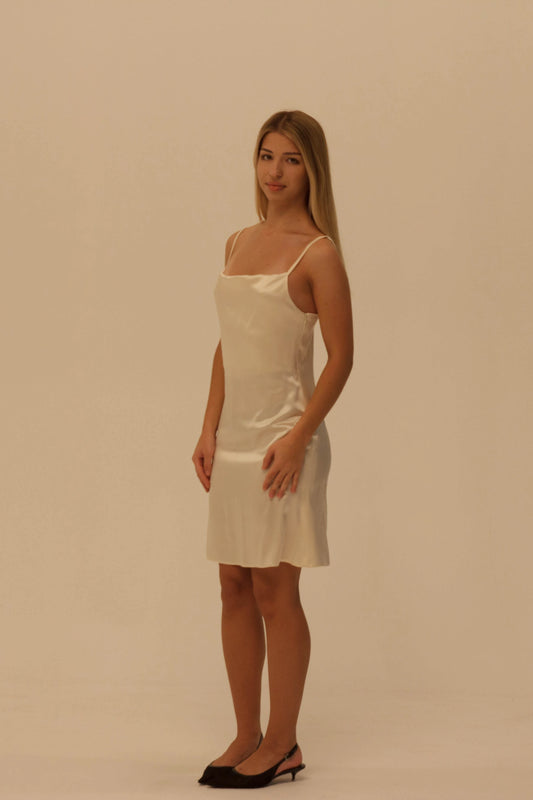
This difference is most visible in bias-cut pieces where drape is the primary design element. A bias-cut silk dress lined in silk moves as a single, coherent unit with its own fluid character. The same dress lined in polyester will cling to whatever is underneath whenever conditions favor static generation, which includes dry weather, central heating, and synthetic fiber undergarments.
In a tailored piece like a wool skirt or a structured coat, static cling pulls the garment against the body in unintended ways, disrupting the silhouette that the tailoring created.
Temperature Regulation: The Daily Experience
This is the function where polyester lining most obviously fails in daily wear, and where the difference is most immediately perceptible.
Silk is a protein fiber structurally similar to skin and hair. It regulates temperature through two mechanisms: moisture absorption and thermal conductivity.
Silk absorbs up to 30 percent of its weight in moisture vapor without feeling damp. This means it takes up body moisture from the microclimate between the garment and the skin, holding it in the fiber rather than allowing it to accumulate as liquid against the body. As conditions allow, silk releases this moisture back into the air. The result is a garment that feels comfortable across a range of temperatures because the moisture is managed rather than allowed to build up.
Silk's thermal conductivity sits between cotton and wool: it neither holds heat aggressively nor disperses it rapidly. In warm conditions, silk allows heat to dissipate through the garment rather than trapping it. In cool conditions, it provides a degree of insulation. The behavior is not dramatic in either direction, but it is appropriate: a silk-lined coat is cooler to wear on warm days than the same coat lined in polyester.
Polyester absorbs virtually no moisture. When the body produces moisture vapor, polyester cannot take it up. The moisture accumulates at the skin surface, eventually condensing. The sensation is familiar: the inside of a polyester-lined coat feels warm and slightly damp after sustained wear, even before any visible sweating occurs. The moisture has nowhere to go.
Polyester also has low thermal conductivity, meaning it traps heat against the body rather than allowing it to dissipate. A polyester-lined garment runs warmer than a silk-lined garment in the same outer fabric. In the context of a coat designed for cool weather, this might sound like an advantage. In practice, the inability to regulate moisture means that warmth and clamminess arrive together, which is not comfortable.
The temperature regulation difference is most significant in two contexts: transitional weather where the wearer moves between outdoor and indoor temperatures repeatedly, and formal occasions where physical comfort matters for sustained periods of several hours. In both cases, silk-lined garments maintain a stable, comfortable interior climate in a way that polyester cannot.
Drape and Movement: The Structural Contribution
A lining is not passive. It contributes to how the outer fabric moves by providing the interior layer against which the outer fabric slides and from which the overall drape of the garment is partly determined.
In a well-lined garment, the outer fabric and the lining move with a slight independence from each other. The outer fabric responds to body movement and gravity. The lining responds slightly differently because it has its own weight and drape characteristics. The combination of two layers moving with slight independence produces a quality of movement that a single unlined layer cannot achieve: more fluid, more dimensional, more responsive to subtle body movement.
Silk lining contributes to this movement because silk itself has drape. A silk lining at adequate weight adds a soft mass to the interior of the garment that moves with the outer fabric in a coordinated but not identical way. The two layers complement each other.
Polyester lining, particularly at the low weights typically used in production, has minimal drape. It is light and relatively stiff. Rather than contributing movement to the outer fabric, it can impede it, creating a slight stiffness in the combined garment that neither layer would have independently. This is most visible in bias-cut pieces, where the fluidity of the movement is the entire design, and where a stiff interior layer is immediately apparent in how the garment moves when worn.
The weight difference also matters. A silk lining adds appropriate mass to the interior of a garment without making it heavy. This mass contributes to the garment hanging correctly and falling straight when not in motion. Very lightweight polyester lining adds almost no mass, which means the garment's hang depends entirely on the outer fabric rather than on the combined weight of both layers.
Durability: The Long-Term Comparison
Lining failure is one of the most common reasons quality garments become unwearable before the outer fabric shows significant wear.
The failure modes of polyester lining are predictable and progressive. Pilling begins at high-friction points and spreads. The fabric surface becomes rough, which increases friction against the outer fabric and skin, which accelerates further pilling. Eventually the lining looks and feels poor enough that the garment is unpleasant to wear despite the exterior remaining intact.
Polyester is also sensitive to dry cleaning chemicals. Most dry cleaning uses perchloroethylene or hydrocarbon solvents. These chemicals affect polyester differently than they affect natural fibers: polyester can lose some of its surface structure with repeated solvent exposure, and the dyes used in polyester linings are more susceptible to solvent-related color change than natural fiber dyes. A polyester lining that has been dry cleaned many times often shows a dulling or color shift that the outer fabric does not.
Silk lining failure is different in character and typically slower in onset. Silk can weaken over time from UV exposure (which is why storing lined garments in direct light is inadvisable), from repeated contact with strong chemicals including alkaline detergents, and from mechanical stress. But silk that is correctly cared for, stored away from light and cleaned correctly, maintains its integrity across decades of use. The protein fiber structure resists the mechanical degradation that polyester shows under repeated friction.
The practical consequence: a silk-lined garment in which the owner invests in correct care may never need relining. The lining outlasts the question. A polyester-lined garment typically needs relining after seven to fifteen years of regular wear, sometimes sooner depending on frequency of use and care standards. Relining is expensive, between €100 and €500 depending on the garment complexity, and adds a cost to ownership that is not visible in the original purchase price.
The Cost Question
The cost difference between silk lining and polyester lining per garment is real but smaller than most buyers assume.
For a full-length coat requiring approximately 2 to 2.5 meters of lining fabric, the material cost difference between standard polyester lining and quality silk lining at appropriate weight is roughly €30 to €80 at wholesale fabric prices. On a coat retailing at €800 or above, this is a small percentage of the retail price.
The reason most brands choose polyester is not that silk is prohibitively expensive. It is that polyester is cheaper at any price point, and the difference is invisible to most buyers at the point of purchase. The decision to use silk lining is therefore a deliberate choice to spend more on a component that most buyers do not inspect and that does not appear in any marketing material.
It is, in other words, a decision made for the garment rather than for the sale.
Cupro: The Middle Option
Cupro deserves mention because it is used by some quality brands as an alternative to silk lining that is better than polyester but less expensive than silk.
Cupro is a regenerated cellulose fiber made from cotton linter (the short fibers removed from cotton seeds). It has several properties that make it a legitimate lining alternative: it is breathable, it does not generate static, it has good drape, and it is soft against skin. It absorbs moisture better than polyester, though less than silk.
Its limitations are also real. Cupro is less durable than silk under repeated mechanical stress. It is sensitive to water and can shrink or distort if not dried correctly. Its temperature regulation is good but not equivalent to silk's. It does not have silk's longevity.
For garments in the mid-quality range, cupro lining is a meaningful upgrade from polyester. For investment pieces intended to last decades, silk remains the correct specification.
How to Check the Lining Before Purchasing
The lining material is disclosed on the care label in most markets. The label inside a garment typically shows fiber content for both the outer fabric and the lining, often listed separately.
Look for: "Lining: 100% silk" or "Doublure: 100% soie." Any percentage of polyester in the lining is polyester lining at that proportion.
If the care label does not specify lining separately, touch the lining fabric directly. Silk has a specific cool-against-skin quality and a smoothness that is distinct from polyester. Polyester often feels slightly warmer and has a subtle plasticity to its surface that silk does not. Running the fabric across the inner wrist rather than the palm gives a more accurate tactile reading.
The test is not definitive without fiber identification, but experienced handling makes it reliable enough to identify obvious polyester in most cases.
The Summary
Silk lining is used in quality garments because it performs every lining function better than polyester: it protects the outer fabric from abrasion without pilling, it eliminates static cling, it regulates temperature through moisture absorption and appropriate thermal conductivity, it contributes to drape rather than impeding it, and it lasts as long as the garment it lines.
Polyester lining is used in most garments, including expensive ones, because it is cheaper and the difference is not visible at the point of purchase.
The choice of lining material is one of the clearest indicators of whether a brand is building garments for the wearer's experience over years of use, or building garments for the point of sale. These are different objectives, and the lining is where the difference is most honestly expressed.
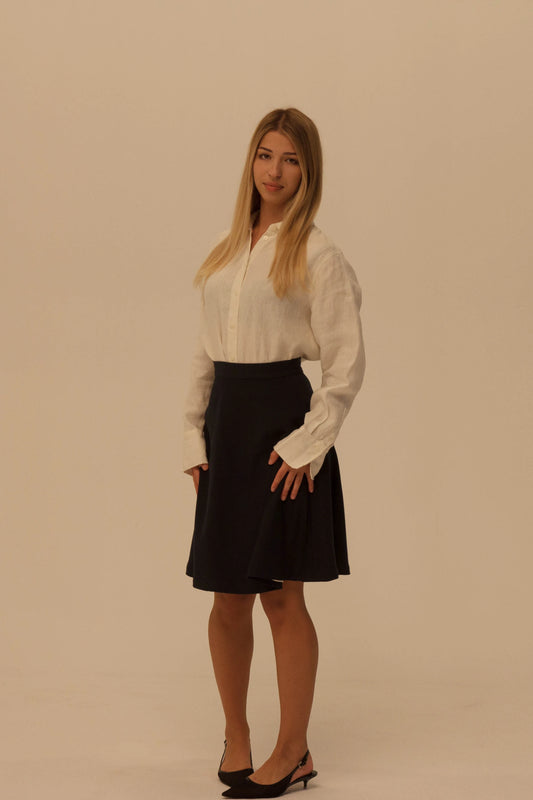
Bradic tailored pieces use full mulberry silk lining. The Midnight Blue Wool Skirt is fully lined in mulberry silk. The specification is in the product description.