Bias-Cut Silk Dresses: What Most Brands Get Wrong
You buy a beautiful bias-cut silk dress online. The photos show it draping elegantly, skimming the body like liquid.
It arrives. You try it on.
It twists. It pulls. It clings in the wrong places and gapes in others. The hem is uneven. After one wear, the seams have stretched and the whole dress looks distorted.
This isn't your fault. And it's not bad luck.
It's that many brands fundamentally misunderstand how to make bias-cut silk dresses, and they're selling you pieces that are structurally doomed to fail.
Here's what they're getting wrong, and how to spot a bias dress that will actually work.
What Is Bias Cut? (The Technical Reality)
Before we can discuss what goes wrong, we need to understand what bias cut actually means.
The Basics
Grain direction in fabric:
All woven fabric has three grain directions:
- Lengthwise grain (warp): Runs parallel to the selvage edge. Very stable, minimal stretch.
- Crosswise grain (weft): Runs perpendicular to the selvage. Slightly more stretch than lengthwise.
- Bias grain: Runs at a 45-degree angle to the selvage. Maximum stretch and drape.
Standard garment construction: Most clothing is cut on the lengthwise or crosswise grain for stability and predictability.
Bias-cut construction: The fabric is cut at a 45-degree angle to the grain, placing the most stretchy, fluid part of the fabric in the garment body.
Why This Matters
When fabric is cut on the bias:
It becomes elastic: The weave structure allows the threads to shift and stretch diagonally, creating movement in all directions.
It drapes differently: Instead of hanging straight and stiff, bias fabric flows and molds to curves.
It behaves unpredictably: The fabric can stretch, twist, and distort if not handled expertly.
This is both bias cut's greatest advantage and its biggest challenge.
Done right, it creates the most beautiful, fluid garments imaginable.
Done wrong, it creates expensive disasters.
Why Silk on the Bias Looks Luxurious (The Physics)
Bias-cut silk isn't just a style choice, but physics creating visual magic.

The Drape Factor
Silk's natural properties:
- Smooth, slippery fiber
- Lightweight but substantial (when proper weight)
- Natural sheen that catches light
- Fluid movement
When cut on the bias:
- The fabric's inherent fluidity is amplified
- It skims over curves instead of clinging
- It creates a liquid, flowing silhouette
- The drape is sensual without being tight
The result: That signature "1930s Hollywood" elegance. Think Jean Harlow, Katharine Hepburn, Carolyn Bessette-Kennedy.
The Body-Conforming Effect
Bias fabric doesn't just hang, it interacts with the body.
How it works:
- The diagonal stretch allows the fabric to gently hug curves
- Then release and flow away from the body
- Creating a silhouette that's simultaneously fitted and fluid
- It moves with you, not against you
This is why bias-cut silk dresses photograph so beautifully: The fabric catches light differently at every angle, creating dimension and movement.
The Luxury Signal
There's a reason bias-cut silk dresses command premium prices (when done well):
Technical difficulty: Cutting and sewing bias is exponentially harder than straight grain
Fabric requirement: Bias cutting requires 30-50% more fabric than straight cutting
Expertise required: Only skilled pattern makers and sewers can execute it properly
Fit precision: Bias pieces must be fitted to the individual body to work correctly
When you see a perfectly executed bias-cut silk dress, you're looking at genuine craftsmanship.
When you see a poorly executed one, you're looking at corners cut.
The Most Common Mistakes (Why Your Bias Dress Failed)
Many bias-cut silk dresses on the market have at least one (sometimes several) of these critical flaws.
Mistake 1: Wrong Momme Weight
The problem: Using silk that's too light or too heavy for bias construction.
Why it happens:
- Brands use thin silk (12-16mm) to reduce costs
- Or they use heavy silk (30mm+) without adjusting the pattern
- Neither works properly on the bias
What goes wrong:
Too light (12-16mm):
- Stretches excessively under its own weight
- Becomes see-through and shapeless
- Distorts permanently after one wear
- Seams pull and gap
- Looks cheap despite being "real silk"
Too heavy (30mm+):
- Doesn't drape properly
- Creates bulk at seams
- Weighs down and stretches out of shape
- Loses the fluid quality that makes bias cutting worthwhile
The sweet spot: 19-25mm silk charmeuse or crepe de chine. Heavy enough to have substance and drape beautifully, light enough to be fluid and elegant.
Most ready-to-wear brands use 14-16mm to save money. This is why the dress fails.
Mistake 2: Incorrect Grain Alignment
The problem: The fabric isn't cut at a true 45-degree bias.
Why it happens:
- Factory cutters work quickly and approximately
- Mass production doesn't allow for precision grain alignment
- Brands cut multiple layers at once, causing grain shift
- Pattern pieces are nested to save fabric, compromising true bias
What goes wrong:
When grain is off even by a few degrees:
- The dress twists on the body (side seams spiral forward or back)
- Drape is uneven (one side hangs differently than the other)
- Hem becomes crooked (impossible to fix)
- Fabric stretches unevenly (creates distortion)
This is the most common flaw in ready-to-wear bias dresses, and the hardest to fix.
Once a dress is constructed on incorrect grain, there's no remedy. The piece is fundamentally flawed.
Mistake 3: No Stabilization at Stress Points
The problem: Bias fabric stretches. Without proper stabilization, it stretches too much in the wrong places.
Critical stress points in bias dresses:
- Shoulders and neckline (bear the weight of the dress)
- Armholes (constant movement and friction)
- Hip area (sitting causes stretching)
- Hem (gravity pulls on the bias, causing lengthening)
What proper stabilization looks like:
- Shoulder seams are reinforced with narrow twill tape sewn into the seam
- Necklines have stay-stitching or lightweight interfacing
- Armholes are carefully finished to prevent stretching
- Hems are allowed to hang for 24-48 hours before final hemming (bias fabric "grows" as it hangs)
What most brands do:
- Nothing. They sew the dress like a standard garment.
- Or they add heavy interfacing that defeats the purpose of bias (creates stiffness)
The result:
- Necklines stretch out and gape after one wear
- Shoulders sag and lose shape
- Armholes become distorted
- The hem becomes wavy and uneven
- The dress "grows" 2-3 inches in length after wearing
You wear it once, and it no longer fits.
Mistake 4: Standard Sizing for a Non-Standard Construction
The problem: Bias-cut dresses are sold in S/M/L or standard numeric sizing.
Why this doesn't work:
Bias fabric conforms to the body. This means:
- It requires precise measurements to fit correctly
- It reveals every fit issue (unlike structured garments that hide them)
- Body proportions matter more than overall size
- Standard sizing assumes an "average" body that doesn't exist
What happens with standard sizing:
If the dress is too small:
- The bias pulls tight across curves
- Creates unflattering cling
- Seams strain and can split
- The drape is destroyed (defeats the purpose of bias)
If the dress is too large:
- Excess fabric pools and sags
- The silhouette becomes shapeless
- You lose the body-skimming effect
- It looks sloppy instead of elegant
The truth: A bias-cut dress has a very narrow margin for fit error. Off by an inch in the bust, waist, or hip, and the entire drape is compromised.
Standard sizing cannot account for this precision.
This is why even expensive ready-to-wear bias dresses often don't fit quite right.
Mistake 5: Cheap Construction Methods
The problem: Bias requires specialized sewing techniques. Most brands use standard methods.
What proper bias construction requires:
French seams or enclosed seams:
- Hide raw edges (which fray more on bias)
- Create clean interior
- Add subtle structure without bulk
Directional sewing:
- All seams sewn in the same direction (prevents stretching)
- Sewn carefully to avoid pulling the fabric
- Often requires hand-basting first
Proper pressing:
- Bias seams must be pressed carefully (never stretched)
- Steam is used minimally (can distort)
- Seams are pressed over curves to maintain shape
Hanging time:
- Dress must hang on a form for 24-48 hours before hemming
- Allows fabric to "relax" and settle into its final shape
- Prevents hem irregularities
What most brands do:
- Machine sew quickly without basting
- Use overlocked seams (unravel on bias)
- Press aggressively (stretches fabric)
- Hem immediately without hanging time
The result: A dress that looks fine initially but distorts with wear.
Why Ready-to-Wear Almost Always Fails
The fundamental issue: mass production and bias cutting are incompatible.
The Economics of RTW Bias Dresses
What makes RTW profitable:
- Cutting multiple layers at once (30-50 layers)
- Fast production (minimize labor costs)
- Standard sizing (one pattern for many bodies)
- Minimal finishing (reduce hand work)
What makes bias cutting successful:
- Cutting single layers carefully (maintaining exact grain)
- Slow, precise construction (skilled hand work)
- Individual fitting (each body is different)
- Extensive finishing (stabilization, hanging, hand-hemming)
These requirements are opposites.
The Compromise Spiral
To make bias dresses profitable in ready-to-wear, brands compromise:
Step 1: Use cheaper, lighter silk (saves fabric cost, reduces drape quality)
Step 2: Cut less precisely (saves cutting time, destroys grain alignment)
Step 3: Skip stabilization (saves labor, causes stretching and distortion)
Step 4: Use standard sizing (enables mass production, ensures poor fit)
Step 5: Construct quickly (increases output, compromises quality)
The result: A dress that looks like a bias-cut silk dress in photos but performs like a cheap imitation in real life.
Why Even Expensive RTW Fails
You might think: "But I bought a €600 bias dress from a designer brand. Surely that's different?"
Often, it's not.
High-end ready-to-wear still uses:
- Standard sizing (slightly more sizes, but still predetermined)
- Factory production (better factories, but still mass production)
- Profit margins that require cutting corners somewhere
The €600 price tag reflects:
- Brand markup (30-50% of the price)
- Marketing costs
- Retail overhead
- Better quality silk (maybe 19mm instead of 14mm)
But the fundamental construction flaws remain:
- It's still made for a standard size, not your body
- It's still cut and sewn quickly
- It still lacks proper stabilization
- It still uses approximation instead of precision
A €600 poorly-fitted bias dress is worse value than a €300 well-fitted straight-grain dress.
When Bias Cut Works (and When It Doesn't)
Bias cutting isn't always the right choice. Here's when it makes sense—and when it's just marketing.
When Bias Cut Works Beautifully
Ideal applications:
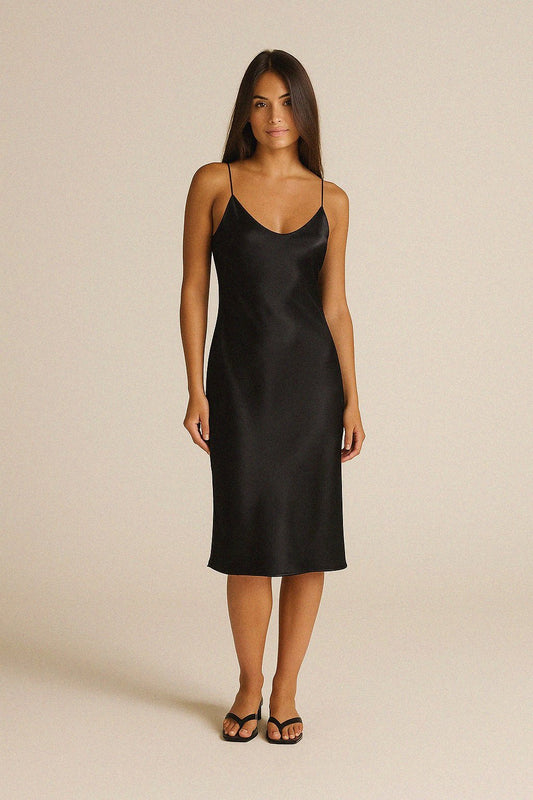
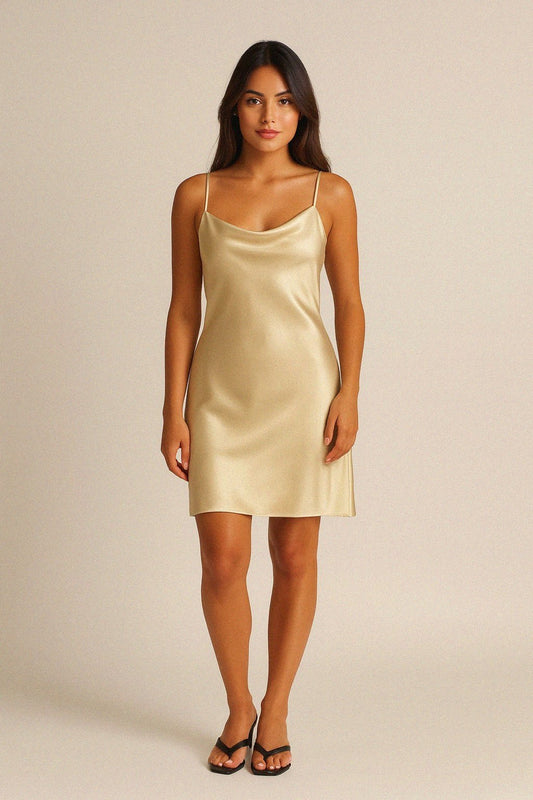
Slip dresses:
- Simple silhouette shows off the drape
- Minimal seams (less opportunity for distortion)
- The fluid drape is the entire point
- Works for various body types when properly fitted
Bias-cut skirts:
- Gorgeous drape and movement
- Skims hips and flows away from body
- Creates elegant, lengthening silhouette
- Easier to fit than full dresses (fewer measurement points)
Evening gowns:
- The drama of bias drape suits special occasions
- Often worn once or rarely (less wear-and-tear stress)
- Worth the investment in proper construction
- Photographs beautifully
Cowl or draped necklines:
- Bias allows fabric to drape into soft folds
- Creates dimension and interest
- Shows off silk's natural fluidity
When it works:
- The garment is simple enough to showcase the drape
- It's properly fitted to the individual body
- The fabric weight is correct (19-25mm)
- Construction quality supports the technique
When Bias Cut Doesn't Work
Poor applications:
Structured blazers or tailored pieces:
- Bias defeats the purpose of structure
- Difficult to maintain sharp lines
- Stretches out of shape with wear
- Better suited to straight grain
Heavily detailed garments:
- Multiple seams create opportunities for distortion
- Details compete with the drape
- Too much happening visually
- Defeats the elegant simplicity of bias
Everyday casual wear:
- Bias requires care (can't be tossed in the wash)
- Stretches with constant wear
- Too precious for daily use
- Not practical for active lifestyles
Very fitted styles:
- Bias is meant to skim, not cling
- Defeats the fluid drape advantage
- Better achieved with stretch fabrics
- Looks and feels uncomfortable
Body Type Considerations
Bias cut works best on:
- Balanced proportions (smooth drape requires even curves)
- Medium height or taller (short torsos can be overwhelmed by fluid fabric)
- Defined waist (bias naturally emphasizes this)
- Confidence in the body (bias reveals rather than conceals)
Bias cut can be challenging for:
- Very petite frames (too much fabric)
- Large height differences between measurements (causes uneven drape)
- Those who prefer structure and coverage
But: With proper made-to-measure fitting, bias can be adapted for almost any body. The key is precision.
How to Recognize a Good Bias Dress Before Buying
If you're shopping for a bias-cut silk dress, here's how to evaluate quality before purchasing.
Check the Fabric Weight
Ask or check the label: What is the momme weight?
19-25mm: Ideal for bias-cut dresses
16-18mm: Can work if construction is exceptional
14mm or below: Will not hold up, avoid
If weight isn't specified, that's already a red flag. Quality brands that understand bias cutting will specify momme weight.
Examine the Grain Alignment
Hold the dress up and look at the side seams:
Should be perfectly vertical when the dress hangs
If seams spiral or twist, the grain is off, don't buy
Check the hem:
Should be even all around when hanging
If one side is longer, grain alignment is incorrect
Look at how the fabric drapes:
Drape should be symmetrical on both sides
If one side hangs differently, the bias is incorrectly cut
Inspect the Construction
Turn the dress inside out:
French seams or clean enclosed seams (indicates care and quality)
Overlocked/serged raw edges (will fray and unravel on bias)
Learn the difference between french and overlocked seams
Check stress points:
Shoulder seams feel slightly reinforced (tape or stay-stitching)
No reinforcement visible (dress will stretch out)
Examine the hem:
Narrow, hand-rolled or hand-stitched hem (proper finishing)
Hem has subtle lettuce edge or gentle wave (natural to bias, shows it was allowed to hang)
Wide machine hem (cheap finishing)
Completely flat, stiff hem (likely hasn't been hung properly)
Test the Fit (If Possible)
When trying on:
The dress should:
- Skim your body without clinging
- Drape smoothly over curves
- Hang evenly all around
- Feel like it's "settling" onto your body
Red flags:
- Pulls across bust, hips, or thighs (too small or poorly cut)
- Gapes at neckline or armholes (will only get worse)
- Hem is uneven (grain is off, unfixable)
- Twists on your body (catastrophic grain error)
The true test: Walk, sit, move naturally. Does the dress move with you fluidly, or does it fight you?
Ask About Construction Time
Question for the brand: "How long does it take to produce this dress?"
2-6 weeks: Often indicates proper construction (hanging time, careful finishing)
1-2 weeks: Possibly acceptable if small-batch production
"In stock, ships immediately": Mass-produced, likely compromised quality
Properly made bias pieces cannot be rushed. If it's available for immediate shipment, it wasn't made correctly.
Evaluate the Price Honestly
Price signals:
€150-300: Almost certainly corners were cut (thin silk, poor construction, factory production)
€400-600: Could be quality if from a smaller brand focused on craftsmanship; could be overpriced RTW from a designer brand
€700-1,200+: Should be exceptional quality (25mm silk, expert construction, possibly made-to-measure)
But remember: High price doesn't guarantee quality. Evaluate construction, not just cost.
The Made-to-Measure Solution
Here's the uncomfortable truth: you cannot mass-produce a perfect bias-cut silk dress.
The technique requires:
- Fabric cut on exact grain for your specific measurements
- Construction adjusted to your body proportions
- Hanging time to allow the dress to settle to your shape
- Hand-finishing at critical points
This is only possible with made-to-measure.
Why We Only Make Bias Pieces to Measure
At Bradic, we don't sell ready-to-wear bias-cut dresses.

Not because we can't. But because we refuse to compromise what makes bias cutting beautiful.
Our approach:
Individual pattern drafting:
- Each dress pattern is created for your specific measurements
- True 45-degree bias maintained throughout
- Adjusted for your body proportions (not a standard size graded up or down)
Proper fabric selection:
- 25mm silk charmeuse
- Grain carefully aligned before cutting
- Single-layer cutting (never stacked)
Expert construction:
- French seams throughout
- Stabilization at shoulders and neckline
- Directional sewing to prevent distortion
- Dress hangs on form for 48 hours before final hemming
Individual fitting:
- Adjusted to your height, bust, waist, hip
- Accounts for body asymmetries
- Creates drape that's perfect for you specifically
This takes time. It requires skill. It can't be rushed or mass-produced.
But it's the only way to create a bias-cut silk dress that will actually work.
What This Means for You
If you buy ready-to-wear bias:
- Accept that fit will be approximate at best
- Expect stretching and distortion over time
- Be prepared to have it altered (though bias is difficult to alter)
- Understand you're compromising on the very thing that makes bias special
If you choose made-to-measure bias:
- It will fit your body exactly
- The drape will be perfect for your proportions
- Proper construction will prevent stretching and distortion
- You'll have a dress that lasts for years and looks better with age
The difference isn't subtle. It's the difference between "this almost works" and "this is perfect."
Final Thoughts
Bias-cut silk dresses are some of the most beautiful garments in fashion, when done right.
But most aren't done right.
They're made cheaply, quickly, and for bodies that don't exist. They use fabric that's too thin, grain that's incorrectly aligned, and construction that can't support the technique.
You deserve better than a dress that looks beautiful for one wear before distorting beyond recognition.
If you're investing in a bias-cut silk dress:
- Look for proper fabric weight
- Inspect construction carefully (French seams, reinforcement, proper hemming)
- Accept that perfect fit requires individual measurements
- Understand that proper construction takes time
Or accept that the ready-to-wear version will be a compromise, and decide if that compromise is worth it.
Bias cutting is too beautiful, too technically demanding, and too special to be executed carelessly.
When it's done right, it's magic.
When it's done wrong, it's just expensive fabric that doesn't fit.
Choose accordingly.