How Luxury Garments Are Finished on the Inside
Miron BradicThe exterior of a garment is designed to sell it. The interior tells you whether it was built to last.
Interior finishing is the most reliable quality indicator available at the point of purchase. It is the part of the garment that was not designed to be seen, which means it reflects the brand's actual construction standards rather than the standards applied to visible surfaces. A brand that finishes the interior well does so because their production standard requires it, not because buyers inspect it.
There are five primary interior finishing methods used in quality garment construction. Understanding what each one is, why it exists, and what it indicates about the garment's construction standard turns a two-minute interior inspection into a useful quality assessment.
French Seams
What they are
A French seam is a two-pass construction that encloses the raw fabric edges completely inside the seam itself. In the first pass, the fabric pieces are sewn with wrong sides together at a narrow seam allowance, typically 6mm. In the second pass, the fabric is folded so right sides are together, the first seam is enclosed inside the fold, and a second seam is sewn at the final seam line position. The result is a seam with no raw edges visible from either side.
What they look like
From the interior: a narrow, clean fold of fabric with nothing else. No raw edges, no overlocking thread, no exposed fiber of any kind. The fold sits flat against the interior of the garment.
From the exterior: nothing. The seam line is visible where the fabric meets, but no interior construction shows through.

Why they exist
French seams solve three problems specific to lightweight and delicate fabrics. First, silk and similar fabrics fray severely at cut edges. French seams eliminate raw edges rather than covering them, which removes the fraying problem structurally. Second, lightweight fabrics are often transparent enough that interior seam finishing shows through to the exterior surface. French seams have minimal bulk, so they do not create a visible shadow through the fabric. Third, enclosed edges cannot abrade against skin or lining, which extends the seam's functional life.
What they indicate
French seams take significantly longer to execute than overlocking and require precision at both passes. They cannot be rushed without producing visible defects. Their presence in a garment indicates that production time per piece was not the binding constraint, which correlates with other quality decisions throughout the construction. In practice, French seams are found almost exclusively in unlined silk garments, lingerie, fine shirting, and high-end childrenswear where interior finishing is visible and fabric vulnerability makes edge enclosure important.
Limitations
French seams add a small amount of bulk at the seam line from the folded edge enclosed inside. In heavy fabrics, this bulk creates a ridge. They are also difficult to execute cleanly on tight curves: the enclosed edge must be clipped to lie flat around curves, and the clips reduce structural integrity if placed too closely. For these reasons, French seams are used primarily in straight or gently curved seams in lightweight fabrics. On complex curved seams in heavier materials, other finishing methods are more appropriate.
Bound Seams
What they are
A bound seam covers the raw edge of a seam allowance with a separate strip of fabric that wraps around and encloses the edge. The binding strip is cut on the bias, which allows it to curve around the seam allowance without puckering, and is folded over the raw edge and stitched in place.
What they look like
From the interior: each seam allowance is encased in a strip of fabric, usually silk, cotton, or rayon, folded neatly around the edge and stitched flat. The result is a clean, defined edge on each seam allowance, distinctly finished.

Why they exist
Bound seams address raw edges in garments where French seams are impractical, typically because the fabric is too heavy for the double-fold required by French construction, or the seam is too curved. They are the standard interior finish in high-quality tailoring, particularly unlined or partially lined jackets and coats. The binding protects the raw edge from fraying and abrasion while producing an interior that looks deliberately finished rather than merely functional.
What they indicate
Binding seams takes time and skill: the binding must be cut accurately, joined at corners without bulk, and stitched without puckering along curves. In traditional tailoring this work is done by hand or with specialist machine attachments. The quality of bound seams is immediately visible: clean, even binding with consistent width throughout indicates skilled execution. Uneven binding, puckering at curves, or binding that pulls away from the edge indicates rushed or unskilled work.
Bound seam finishing is associated with the highest level of tailoring construction. It is found in bespoke and made-to-measure tailoring, in unlined luxury jackets, and in garments where the interior is expected to be seen during wear, such as a jacket that is often removed or carried.
Variations
The Hong Kong finish is a specific type of bound seam finish common enough to warrant separate discussion. It is covered in the next section.
The Parisian bound seam uses silk charmeuse cut on the bias as the binding material. The silk allows the binding to drape and flex with the garment rather than adding stiffness. This variation is associated specifically with French tailoring tradition and Parisian couture.
Hong Kong Finish
What it is
The Hong Kong finish is a bound seam variation where each seam allowance is finished individually rather than both being bound together. A strip of fabric, typically a fine silk, rayon, or cotton, is folded around each raw edge and stitched in place. After finishing, the seam is pressed open so both seam allowances lie flat and away from the seam line, each with its own clean bound edge.
What it looks like
From the interior: pressed open seams with each side's allowance neatly enclosed in a folded strip of binding fabric. The two bound edges lie flat and separate, with the seam allowances pressed away from each other. The overall impression is of deliberate attention to each individual edge.
Why it exists
The Hong Kong finish evolved as a practical alternative to French seams for situations where French construction is impractical: heavier fabrics, complex curves, and garments where the seam must be pressed open for structural reasons. It achieves edge enclosure with less fabric manipulation than a French seam and can be applied to curves that would be difficult to French seam cleanly.
It is also used in garments that are partially lined: the lining covers most of the interior but does not reach every seam. Hong Kong finishing on the exposed seams ensures the entire interior is cleanly finished rather than having some seams enclosed by lining and others left raw.
What it indicates
The Hong Kong finish is a meaningful quality indicator because it takes considerably more time than overlocking. Cutting binding strips on the bias, applying them to each seam allowance individually, and stitching them neatly is labor-intensive. Its presence indicates that the brand applied deliberate finishing to interior seams rather than using the fastest available method.
The quality of execution varies. A well-applied Hong Kong finish has consistent binding width, clean corners, no puckering along curves, and binding that lies flat without rolling. A poorly applied finish has uneven width, puckering, or binding that has been attached without adequate tension control. The finish is visible enough to assess execution quality quickly.
Common applications
Hong Kong finishing is found in high-quality wool jackets and coats, unlined summer blazers, and any garment where complex seaming makes French seams impractical but where interior quality is considered important. It is also used in lined garments on seams that the lining does not reach, ensuring the entire interior is finished to a consistent standard.
Double-Faced Construction
What it is
Double-faced fabric consists of two separate fabric layers connected by interlocking yarns. In construction, this fabric is used to create garments with no lining: the interior face of the fabric is the garment's interior, and because both faces are finished surfaces, no additional interior treatment is required. The edge finishing, however, is one of the most demanding operations in garment construction.
At every perimeter edge of a double-faced garment, the two layers must be separated manually, each layer folded inward independently, and the two folded edges joined by hand stitching that is invisible from both sides. This operation cannot be done by machine. It requires separating the connecting yarns over a working zone of approximately 15mm from the cut edge, folding each layer's face to the outside, and slip-stitching the folded edges together with stitches that penetrate only the innermost threads of each fold.
What it looks like
From both the interior and exterior: a clean edge that appears to simply terminate. No visible stitching, no binding, no raw edge, no finishing element of any kind. The edge looks as though the fabric was made with finished edges rather than cut and finished after weaving.

Why it exists
Double-faced construction solves the lining problem differently from all other methods. Rather than adding a lining to cover interior construction, it makes the interior construction clean enough that no lining is needed. The result is a garment with less total weight, better temperature regulation because no synthetic lining layer is trapping heat, and a more fluid drape because the garment responds only to the outer fabric's weight rather than the combined weight of fabric and lining.
What it indicates
The hand-finishing time required for a double-faced coat is substantial: 8 to 14 hours per piece for perimeter edge finishing alone, excluding seam construction. This time cost makes double-faced construction one of the most expensive finishing methods available. It is found primarily in high-end outerwear from established tailoring traditions and in small-production ateliers where individual attention per piece is structurally possible.
The quality of double-faced finishing is assessable by flexing the finished edge gently: correctly finished edges move as a single unit without any separation between the layers. The corner miters should be flat and sharp. No stitch should be visible from either side. Any visible thread, any slight separation between layers, or any waviness along the edge indicates execution below the standard the method requires.
Common applications
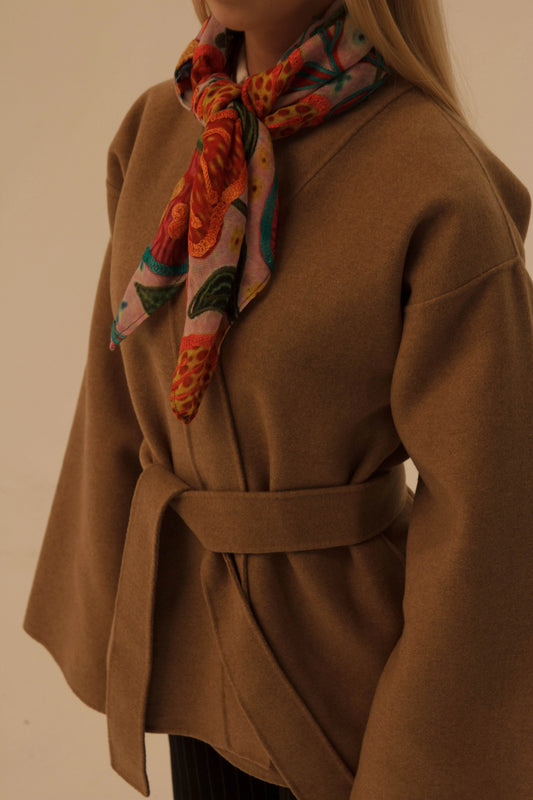
High-end wool and cashmere coats, wrap coats, minimal blazers in double-faced materials. Not appropriate for structured tailoring where interior canvas and seam structure are necessary components.
Unlined Tailoring
What it is
Unlined tailoring is structured garment construction without a lining, where all interior seams and construction elements are finished to a visible standard. In a fully lined jacket, the lining covers everything: seam allowances, canvas interfacing, padding, and all structural elements can be left at any standard because they will not be seen. In an unlined jacket, every interior element is visible and must be finished deliberately.
Unlined tailoring typically uses a combination of the methods above, bound or Hong Kong-finished seams throughout, with careful attention to how internal structural elements are attached and finished. The canvas interfacing, if present, is attached with pick stitching rather than machine topstitching so it is visible as a deliberate element rather than an industrial process. Seam allowances are bound or Hong Kong-finished. Hems are hand-stitched.
What it looks like
From the interior: a garment that appears almost as considered as the exterior. Bound seam allowances pressed flat and even. Pick-stitched canvas with consistent, fine stitching. Hand-stitched hems. Clean, consistent construction throughout with no elements concealed by lining.
Why it exists
Unlined tailoring originated in contexts where weight and breathability were priorities: summer suiting in hot climates, lightweight jackets for transitional weather. Without the additional weight and heat retention of a lining, an unlined jacket is significantly cooler to wear than a lined equivalent in the same outer fabric.
It also exists as a demonstration of construction standard. An unlined garment's interior is fully exposed, which means there is no possibility of concealing shortcuts. Every construction decision is visible. This makes unlined tailoring a more demanding standard to achieve than lined tailoring: in lined construction, only the exterior needs to be excellent. In unlined construction, everything does.
What it indicates
High-quality unlined tailoring is among the strongest quality signals available in a garment, because the absence of lining means the interior must be finished to a standard that reveals the true production quality. The bound seams, the hand stitching, the canvas attachment: these are all visible and assessable.
Poor execution of unlined tailoring is also visible in ways that lined construction conceals. Uneven seam binding, inconsistent hand stitching, or canvas that is attached without care are all immediately apparent in an unlined piece. The method demands quality. Whether the quality is there or not is something you can see.
Common applications
Summer jackets and blazers, lightweight travel jackets, and any tailored piece where the weight reduction from removing the lining is a design priority rather than a cost reduction.
Reading the Interior: A Practical Guide
Turn any garment inside out before purchasing. Thirty seconds of inspection across these five methods tells you more about production standard than any exterior detail or price tag.
|
What you see |
Method |
Quality signal |
|
Clean fold with no raw edges, nothing else |
French seam |
High: deliberate edge enclosure, labor-intensive |
|
Each seam allowance wrapped in binding fabric, pressed open |
Bound seam |
High: deliberate finishing, traditional tailoring standard |
|
Each seam allowance individually wrapped, pressed flat |
Hong Kong finish |
High to medium: good finishing, common in quality RTW |
|
Both faces visible, no lining, edge terminates cleanly |
Double-faced |
Very high: hand finishing, extremely labor-intensive |
|
Clean interior, all seams bound, no lining |
Unlined tailoring |
Very high: all interior elements must meet exterior standard |
|
Thread looping around raw edges |
Overlocked seam |
Standard: functional minimum, appropriate for lined garments |
|
Raw edges with minimal finishing |
Unfinished |
Low: shortcuts taken where inspection was not expected |
The presence of any of the first five methods indicates that the production standard was applied to non-visible surfaces as well as visible ones. This correlates strongly with quality decisions throughout the rest of the construction: pressing standards, stitch density, seam allowance generosity, and material selection.
The interior of a garment is where the brand's actual construction philosophy is expressed without the influence of marketing. It is the most honest part of any piece of clothing. It takes thirty seconds to read and tells you most of what you need to know.