Inside the Construction of the Midnight Blue Wool Skirt
Miron BradicA simple skirt is never simple. Here is exactly what goes into making one correctly.
Pick up a well-made wool skirt and it feels like it has an opinion. It holds its shape. It falls cleanly. It sits at the waist without pulling or shifting. When you move, it moves with you rather than against you.
That quality doesn't come from the design. The design of a tailored A-line skirt is about as uncomplicated as clothing gets. It comes from every decision made between the fabric arriving as a length of cloth and the finished piece leaving the atelier. Material choice, pattern development, cutting precision, construction sequence, pressing, lining. Each step either adds to the final result or compromises it.
This is the process behind the Midnight Blue Wool Skirt, documented in the order it actually happens.
Fabric Selection
Everything starts here. A skirt is only as good as the fabric it's made from, and wool is not a single material. It's a category that ranges from cheap, scratchy blends that lose shape within a season to fine virgin wool that holds structure for decades and improves with careful wear.
The fabric used here is 100% virgin wool at 240 GSM.
Virgin wool means the fiber has not been previously processed or recycled. It comes directly from the fleece, retains the natural crimp and elasticity of new fiber, and has not been subjected to the mechanical stress of reprocessing. The result is a fabric with better drape, better resilience, and better longevity than recycled equivalents.
240 GSM sits in a specific range that is worth understanding. At this weight, the fabric is substantial enough to hold an A-line silhouette without internal boning or heavy interfacing, but light enough to move naturally and not create unnecessary bulk at the waistband or hem. Heavier wool, in the 350 to 450 GSM range used for coats, would produce a skirt that stands away from the body. Lighter wool, below 180 GSM, would require additional structure to hold the A-line shape cleanly. 240 GSM is the weight at which the fabric carries the design without fighting it.
Midnight blue as a color choice is worth a brief note because it affects more than aesthetics. True midnight blue sits between navy and black in depth, reading as almost neutral in low light while retaining warmth and dimension in direct light. It works with the entire spectrum of neutrals, from cream and ivory through camel, grey, and black, without the starkness that pure black can create. It is one of those colors that has no expiry date. A midnight blue wool skirt made correctly will be as relevant in fifteen years as it is today.
The weight of the fabric also determines how the finished skirt falls. At 240 GSM, the wool has enough mass to create a clean, fluid drop from the waist through the A-line silhouette to the hem. The fabric moves with the body rather than floating away from it, and returns to its resting position after movement without bunching or distorting.
Pattern Development
A pattern is not a template. It is a set of decisions about how flat fabric will wrap a three-dimensional body, and each decision has consequences for fit, movement, and silhouette.
The starting point is a base skirt block, a foundational pattern shape derived from standardized body measurements that serves as the starting geometry for the design. In mass production, this block is fixed and the garment is graded up and down in size from it. In made-to-measure production, the block is adjusted for each individual set of measurements before any cutting begins.
For this skirt, four measurements determine the pattern: waist circumference, hip circumference, waist-to-hip distance, and desired length. Each of these does something specific.
Waist and hip circumference determine the overall scale of the pattern and the amount of shaping required between the two points. The difference between these two measurements determines how much the side seams need to angle outward from waist to hip, which controls the silhouette.
The waist-to-hip distance is the measurement most people don't think about but that has a significant effect on fit. The standard distance used in ready-to-wear patterns is approximately 20 to 21 centimeters. But bodies vary considerably. A shorter waist-to-hip distance means the widest point of the hip sits higher on the torso. If the pattern places the hip shaping lower than where the body actually is, the skirt will pull at the hip and sit incorrectly at the waist regardless of how accurate the circumference measurements are. In made-to-measure construction, this distance is measured and the pattern is adjusted accordingly.
Skirt length is the fourth variable and affects proportion as much as practicality. A skirt that falls to the knee on one person falls mid-shin on another with the same waist measurement. Custom length means the hemline is where it should be for the specific wearer, which affects how the silhouette reads and how the skirt relates to footwear.
The A-line silhouette introduces one additional pattern consideration: ease of movement. A skirt that fits precisely at the waist and hip with no additional ease would restrict stride. The A-line flare below the hip provides natural movement allowance, but the degree of flare and where it begins needs to be calibrated so the skirt moves freely without losing its clean line when standing still.
Cutting the Fabric
Pattern development produces paper shapes. Cutting translates those shapes into wool, and the translation is not forgiving.
The first thing a cutter establishes before touching the fabric is grain line. Wool, like all woven textiles, has a warp (lengthwise threads) and a weft (crosswise threads) running at 90 degrees to each other. The grain line on the pattern piece indicates how that piece should align with the warp threads of the fabric. For a skirt panel, the grain line typically runs parallel to the center front and center back, meaning the warp threads run vertically on the finished garment.
Why this matters is not immediately obvious until you see what happens when it goes wrong. Fabric cut off-grain hangs unevenly. The skirt will twist to one side during wear, the hem will rise on one side and drop on the other, and no amount of pressing or adjustment will fix it permanently because the problem is structural. The fabric's behavior is determined by its weave, and a misaligned weave creates a garment that fights its own construction.
Cutting on grain is not difficult. It requires attention and time. The pattern piece is laid on the fabric, the grain line is measured against the fabric's selvedge (finished edge) at both ends of the pattern piece until both measurements are equal, and only then is the piece cut. In production environments where speed takes priority over precision, this step is often approximated rather than measured. The consequences appear in the finished garment.

The cutting itself is done with sharp shears in single, clean strokes that follow the pattern edge exactly. Ragged or angled cuts create seam allowances of inconsistent width, which means the pieces won't join at the correct dimensions when sewn. At the scale of a single skirt panel, a two-millimeter deviation in cutting can produce a five-millimeter deviation in the finished seam position, which is visible in the final silhouette.
Construction
With fabric pieces cut accurately, construction begins. For a tailored A-line skirt, the construction sequence follows a specific logic: panels first, then waistband, then closure, then lining.
Joining the Panels
The skirt panels are joined at the side seams with a seam allowance wide enough to allow adjustment if needed. In this skirt, the seam allowance is generous, which serves two purposes. It provides material for any fit adjustments identified during the made-to-measure process, and it contributes to the quality of the finished seam by giving the fabric at the seam line enough support on either side.
The seams are sewn, then pressed open flat. Pressing each seam before moving to the next step is not optional in quality construction. An unpressed seam creates bulk that distorts every subsequent construction step. A pressed seam lies flat and becomes part of the fabric's structure rather than fighting against it.
Waistband Construction
The waistband is a separate piece of fabric that finishes the top of the skirt and provides the structural anchor for the closure. In this skirt, it is cut from the same midnight blue wool as the body, which means the waistband is a continuous visual element rather than a contrasting finish.
The critical detail in waistband construction is the interfacing. This skirt uses fabric interfacing applied to the interior of the waistband, which provides the firmness needed to hold the waistband's shape through repeated wear without the stiffness that fusible interfacing can create. Fabric interfacing moves more naturally with the garment, is more durable over time, and does not risk the bubbling or separation that fused interfacing develops after repeated dry cleaning.
The waistband is attached to the skirt body, then folded and finished at the interior so that the finished edge lies clean against the lining. The top edge of the waistband is the most visible structural element of the skirt and requires particular precision in pressing and finishing so it lies flat and even around the entire circumference.
The Closure
The closure system combines a hidden zip with a hook and eye at the waistband, and the two work together to serve different structural functions.
The hidden zip (also called an invisible zip) is sewn into one side seam using a specialized foot that holds the zip coil away from the fabric during sewing, allowing the stitch to be placed as close to the coil as possible. When properly installed, the zip is completely invisible from the exterior of the garment: no zip tape, no visible teeth, only the pull tab accessible at the waistband. An incorrectly installed invisible zip shows a slight ridge along the seam line or gaps where the coil isn't fully closed. Correct installation requires the zip to be steamed flat before sewing, attached with consistent tension, and pressed carefully after installation.

The hook and eye at the waistband handles a different kind of stress. When a skirt is worn, the greatest tension on the closure occurs at the waistband level where the circumference difference between waist and hip creates a pulling force. A zip alone at this point would experience stress at the top stop, which is a common failure point. The hook and eye distributes this stress across a separate fastening that is designed for it, protecting the zip and creating a more secure closure overall.
Seam Finishing
The interior seams are finished to a high standard. They won't be visible in the finished garment because the silk lining covers them entirely, but this is not a reason to finish them poorly. The seam finish affects the long-term behavior of the seam and the interior quality of the piece. A carelessly finished seam under a lining can still fray, bunch, or create irregularities that show through the lining surface over time.

Fit Adjustments
Because this skirt is made-to-measure, the construction process includes a fitting stage where the garment is assessed on the specific body it was made for, and any deviations from ideal fit are corrected before final finishing.
At this stage the skirt is largely constructed but not fully finished. The hem is not set, the lining is not attached, and the waistband may not be fully finished at its interior. This allows meaningful adjustments to be made without undoing completed work.
The adjustments that typically occur at this stage are small in measurement but significant in result. A side seam taken in or let out by two or three millimeters changes how the skirt sits at the hip. The waistband adjusted by a few millimeters changes whether it sits flat or tends to roll. The hem marked at the precise length for this person, standing in the shoes they'll wear the skirt with, ensures the hemline falls correctly rather than according to a generic length calculation.
Made-to-measure fitting is not about dramatic alterations. If the pattern development was done correctly from accurate measurements, the skirt should be close to correct at this stage. The fitting identifies and corrects the small deviations between measurements on paper and the three-dimensional reality of a specific body. These small deviations are what separate a skirt that fits from a skirt that fits well.
Pressing and Finishing
Pressing is half the work of tailoring. This is not an exaggeration.
Every seam in this skirt is pressed at three stages: after initial sewing to set the stitch, after trimming to remove bulk, and after any subsequent construction that affects that seam's position. The waistband is pressed at each stage of its construction. The hem is pressed after it is set. The finished skirt is pressed in its entirety before lining attachment, and again after the lining is in place.
The tool used for pressing tailored wool is a steam iron with a pressing cloth, or a tailoring ham for curved areas. The ham is a firm, densely stuffed cushion shaped to create convex and concave pressing surfaces that match the curves of a garment. Pressing the hip curve of a skirt over a tailoring ham allows the iron to apply pressure to the curved seam without flattening it in the wrong direction, which would distort the shape.
Proper pressing of wool requires steam, firm pressure, and time. The steam penetrates the fibers and allows them to be repositioned. The pressure sets the repositioned fibers in their new configuration. The time, allowing the fabric to cool and dry completely before moving, ensures the configuration holds. Pressing too quickly, before the fabric has cooled, allows the fibers to spring back toward their original position and the effect of the pressing is lost.
The hem is set at the length marked during fitting, folded up evenly, and hand-stitched with a slip stitch that is invisible from the exterior. The stitching catches only a thread or two of the outer fabric with each stitch so no stitch is visible on the outside of the skirt. This takes more time than a machine hem. It produces a result that lies flatter, moves more naturally, and looks better.
The Lining
The lining is mulberry silk, and it covers the entire interior of the skirt including the waistband facing.
Mulberry silk is the highest grade (6A) of silk, produced by silkworms fed exclusively on white mulberry leaves. The resulting fiber is finer, more uniform, and stronger than that produced by silkworms raised on other food sources. At the weights used for lining fabric, it is smooth against skin and clothing, breathable, and durable enough to last the life of the outer garment when the skirt is cared for correctly.
The silk lining is cut slightly larger than the wool shell to allow ease of movement. A lining cut to the exact same dimensions as the outer fabric would pull against the wool with every step, creating stress on both the lining seams and the wool seams beneath them. The additional ease allows the two layers to move somewhat independently, which is how they should function.
The lining is attached at the waistband, folded under at its lower edge to create a clean interior finish, and slip-stitched by hand so the hem of the lining hangs freely from the skirt's wool hem. This allows the lining to move with the skirt rather than being rigidly fixed, which extends the life of both layers and maintains the skirt's drape.

When the finished skirt is worn, the silk lining is what contacts the skin and clothing. The experience of putting on the skirt, the smoothness of it, the way it slides on without catching, is the lining doing its job. The wool never touches the wearer directly. What the wearer feels is silk. What they see from the outside is wool. The two materials are doing entirely different things, and the quality of each was chosen accordingly.
How the Finished Skirt Should Fall
A correctly made A-line wool skirt at 240 GSM should do specific things.
At the waist, it sits flat and even with no rolling or gaping at the waistband. The closure lies flat with no ridge or pulling. The waistband width is consistent all the way around.
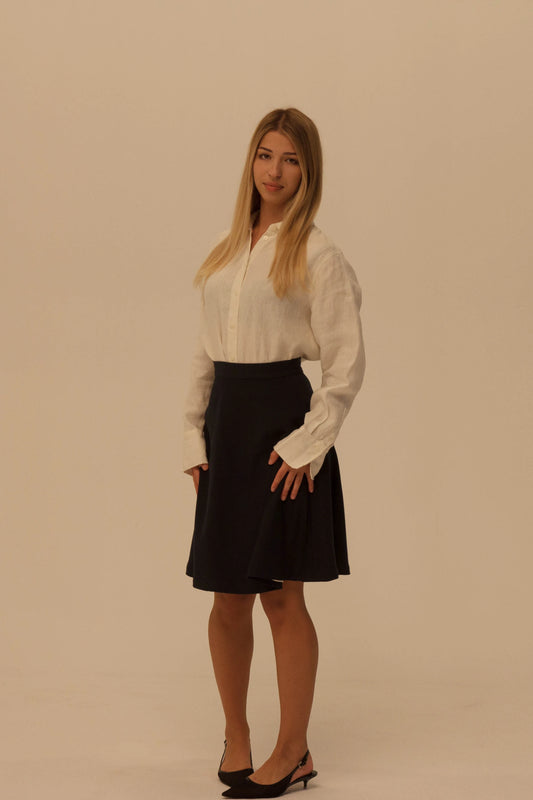
Through the hip, the A-line flares gradually and evenly. There is no pulling across the hip or thigh, no horizontal stress lines in the fabric, no bunching at the side seams. The silhouette is clean from every angle.
The hem falls at a consistent distance from the floor all the way around, which is only possible if the hem was set correctly during construction and the fabric was cut on grain. A hem that dips at the back or rises on one side indicates a construction error that cannot be corrected without resetting the hem entirely.
In motion, the skirt swings slightly with each stride and returns to center. The wool has enough weight to move decisively and enough spring to recover. The silk lining moves with the wool rather than against it.
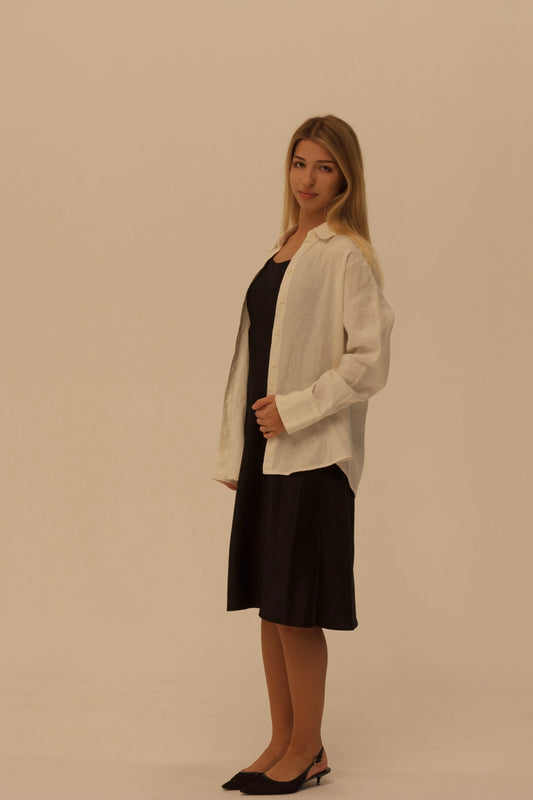
For styling, this skirt works with everything from a simple white shirt to a structured blazer to a fine knit tucked in. The midnight blue reads as a neutral in most combinations, which means it functions as a wardrobe anchor rather than a statement piece. It goes where a well-made skirt should go: everywhere, for years, without drawing attention to itself and without ever looking wrong.
The Difference That Construction Makes
A fast fashion wool-blend skirt at a fraction of this price looks, in a photograph, like it might be the same thing. Same A-line silhouette, same dark color, similar length.
In person, the differences are immediate. The cheaper skirt is lighter, which means it moves less decisively and loses its shape more easily during wear. The seams are visible on the interior and finished by overlock rather than pressed clean. The waistband has fused interfacing that creates a slightly cardboard quality. The lining, if there is one, is polyester and pulls against the outer fabric. The hem is machine-stitched and creates a slight ridge on the exterior.
None of these things is catastrophic. The skirt functions as clothing. But it doesn't have the quality of the finished piece described in this article, and it won't after two years of wear have anything close to the same appearance.
The difference between the two is not primarily the wool or the silk lining, though both matter. It is the accumulated effect of every decision made during construction: pressing at each stage, hand-finished hem, properly installed zip, fabric interfacing, lining with ease, silk rather than polyester. Each individual decision adds a small amount. Together, they produce a garment that is categorically different from what mass production creates.
That difference is not visible in a product photograph. It is not visible at first glance in a store. It becomes visible over time, in how the skirt looks after two years versus how the alternative looks after two years, and in how it feels every time it is worn.
That's what construction quality actually means. Not a better-looking garment today. A better garment for as long as you own it.
The Midnight Blue Wool Skirt is made to your exact measurements in Croatia, in 100% virgin wool with a full mulberry silk lining. Each piece is one of 45.