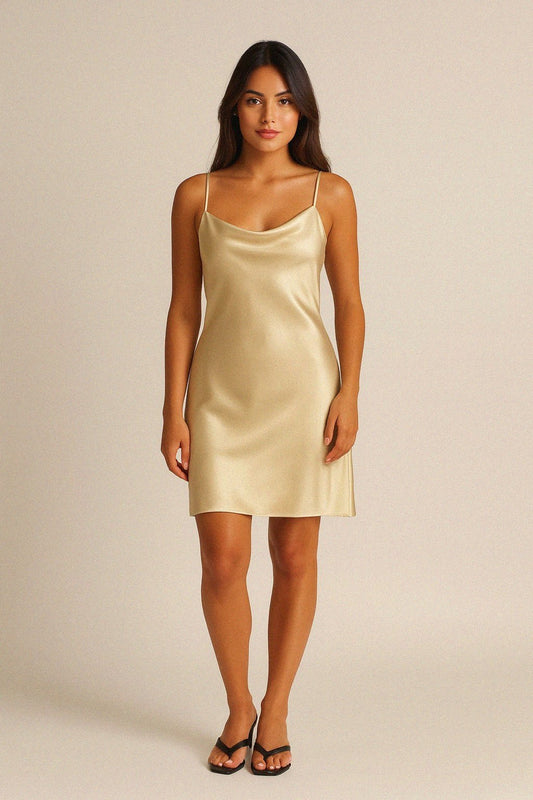
7 Signs a Silk Slip Dress Is Worth the Money
Most of expensive slip dresses aren't worth the price. Here is exactly how to tell the difference before you buy.
A silk slip dress is one of the simplest garments you can own. One piece of fabric, a few seams, two straps. The design has barely changed in a century. Which makes it one of the most honest tests of quality in all of clothing: when the design is this simple, everything comes down to the execution.
Most slip dresses fail that test. The price is high. The silk is thin. The cut is approximate. The piece looks good in photographs and feels ordinary in person. Within a few seasons it shows wear in ways that a genuinely well-made piece would not.
Here are seven specific things that separate a slip dress worth the investment from one that is not.
1. Fabric Weight: The Most Important Factor Nobody Mentions
Silk is measured in momme (mm). This is the weight of the fabric per unit area and it is the single most important quality indicator in any silk garment.
Most slip dresses sold at luxury prices use silk between 12mm and 16mm. This range looks acceptable in photographs and feels pleasant briefly. It is not what quality silk feels like in practice.
A quality made slip dress is made from silk from 19mm upward. At this weight, the fabric has a fluid heaviness that lighter silk cannot replicate. It drapes with authority. It moves with the body rather than floating away from it. It does not cling awkwardly or shift during wear.
You can assess this without any specialist knowledge. Pick up the dress before trying it on. Does it have weight relative to its size? Does it feel substantial in your hands or thin and almost weightless? Lightweight silk looks similar to heavy silk in most photographs. In your hands and against your skin, the difference is immediately apparent.
If the brand does not specify momme weight, ask. A brand confident in its fabric will tell you immediately. If they cannot answer the question, the silk is not something they are proud of.
The fabric weight is the honest part of the garment. Everything else can be designed around. The silk either has substance or it doesn't.
2. Bias Cut: A Construction Decision With Real Consequences
A slip dress can be cut straight on the grain or on the bias, at 45 degrees to the grain. These are not aesthetic choices with equivalent results. They are different constructions that produce different garments.
Straight-cut silk falls vertically from wherever it is attached, which is the straps or the top edge. It does not follow the body's curves. On a hanger, it looks clean. On a body, it can appear boxy or flat, depending on the person's proportions.
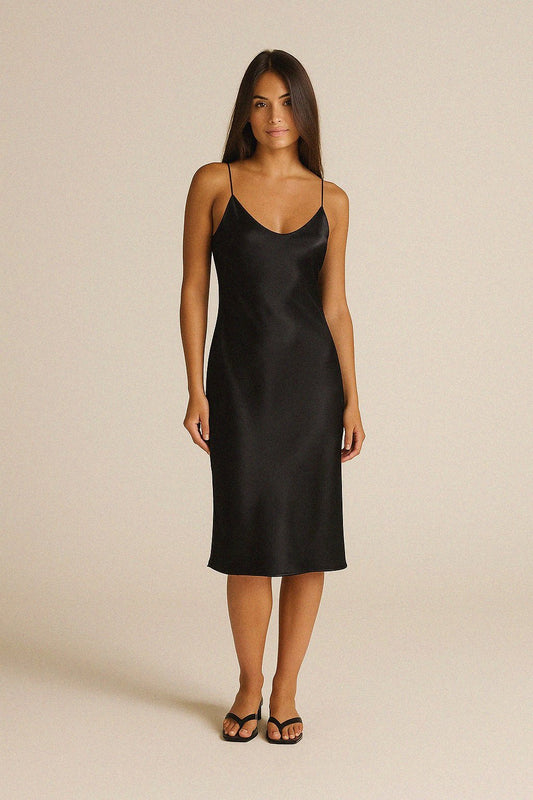
Bias-cut silk drapes around the body. The 45-degree angle makes the fabric elastic in a way that straight-grain silk is not, allowing it to follow curves and return to its natural position after movement. The result is a dress that looks as though it was designed around the wearer rather than hung in front of them.
Bias cutting is significantly more difficult and more wasteful than straight cutting. The pieces must be cut at the precise angle. Any deviation off-bias creates a dress that will twist to one side with wear, which no amount of adjustment or pressing will permanently correct. More fabric is required because the diagonal cuts produce more unusable offcuts. The sewing requires more care because bias-cut fabric stretches during handling and can distort if handled with anything less than consistent gentleness.
The quality brands use bias cut because the result justifies the additional time and material. Brands cutting costs use straight grain and describe it as clean or architectural.
3. Seams That Are Invisible From the Outside
The seams in a quality silk slip dress are French seams. Understanding why this matters is straightforward once you know what a French seam is.
A conventional seam joins two pieces of fabric, leaves the raw edges inside the garment, and finishes them with overlocking or binding. The raw edges are enclosed but present. In heavier fabrics this is adequate. In lightweight silk it creates a slight ridge that can show through the fabric surface.
A French seam encloses the raw edges completely inside a second seam. The result is an interior that has no raw edges at all. Nothing frays. Nothing creates a ridge. The seam is structurally stronger and visually cleaner on both sides.
To check: turn the dress inside out. In a French-seamed dress you will see a thin, folded seam on the interior with no raw edges visible anywhere. In a conventionally seamed dress you will see overlocked edges or raw fabric. The difference is immediate.

French seams take longer to execute and require more precision. They cannot be rushed without showing the rush. Their presence in a garment indicates that someone made a decision to do the work correctly.
4. Strap Construction: The Detail That Fails First
The straps of a slip dress carry the entire weight of the garment and experience more stress than any other part of the construction. They are also, in cheap dresses, the first thing to fail.
Quality strap construction has three characteristics. The straps are cut from the same silk as the dress body, not from a thinner or different fabric. They are reinforced at the attachment points with additional stitching or small internal supports that distribute the stress of wear rather than concentrating it at a single stitch line. And they are adjustable through a mechanism that functions smoothly and will continue to function after years of use.
The attachment point is where you see the quality most clearly. In a cheap dress, the strap is stitched once to the body and that single line of stitching is all that holds it. In a quality dress, the attachment is reinforced in a way that is essentially permanent. Tug the strap gently at the attachment point and assess whether it feels secure or whether there is any give in the connection.
The straps fail in cheap dresses because the attachment was designed for a photograph, not for the stress of being worn repeatedly over years.
5. Fit: The Variable That Ready-to-Wear Cannot Solve
A slip dress is worn close to the body. There is nowhere for a fit problem to hide. A waist that sits slightly high or low, straps that pull because the torso length is wrong, a hem that dips at the back because the bias cut was not corrected for the wearer's specific proportions: all of these are visible in a way that they are not in more structured garments.
Ready-to-wear sizing addresses this with standard measurements and the assumption that buyers will accept an approximate fit. For most garments this is a workable compromise. For a bias-cut slip dress worn against the skin with no structural elements to compensate for fit deviations, approximate is not good enough.
A made-to-measure slip dress is cut to your torso length, your shoulder width, your preferred hem length. The straps are set at the length that works for your specific proportions. The bias cut is corrected, if needed, for how the dress sits on your body specifically. The result is a dress that sits exactly where it should and moves exactly as it should.

This is not a refinement. It is the difference between a dress that looks made for you and one that looks like it fits reasonably well. Both exist. Only one is worth the investment.
6. How the Dress Ages Over Time
Quality silk ages differently from cheap silk, and the difference becomes more apparent with each wear and wash.
Cheap silk at 8mm to 12mm loses its luster relatively quickly. The surface becomes dull. The fabric softens in a way that loses structure rather than gains character. After a year of regular wear and careful washing, it looks like a year-old cheap dress.
Quality mulberry silk at 19mm or heavier ages in the opposite direction. With correct care, the fabric softens slightly while retaining its luster. It develops a quality that is distinct from newness: worn-in rather than worn-out. A well-made silk dress cared for correctly looks better at three years than it did at three months, in the way that good leather or well-made denim does.
The construction also ages differently. French seams do not fray. Quality strap attachments do not weaken. Hems that were hand-stitched do not show their stitching through the fabric after washing. The garment continues to look as constructed as when it was made, because the construction was done correctly the first time.
Assessing longevity before purchase is a matter of evaluating the fabric weight and construction details already described. A dress built correctly will age well. A dress built to look correct at the point of sale will reveal its compromises over time.
7. The Cost-Per-Wear Calculation
A €900 slip dress worn once or twice is expensive. The same dress worn regularly over ten years is not.
The mathematics are straightforward. A dress worn 80 times per year, which for a versatile silk piece worn through multiple seasons is entirely realistic, over ten years represents 800 wears. At €900 purchase price, that is €1.25 per wear.
A €200 dress that looks worn within two years and is replaced three times over the same period costs €600 total, was never as good to begin with, and provided 800 wears at €0.75 per wear. The cheaper dress wins on per-wear cost in this scenario. But it was never the same dress, never the same experience of wearing something well-made, and required three purchasing decisions and three periods of adjustment to a new garment instead of one.
The cost-per-wear argument is not really about mathematics. It is about the quality of the experience across those wears. A dress that fits correctly, is made from fabric that feels exceptional against skin, and ages well is a different object from a dress that costs less and provides approximately the same function. Whether the difference justifies the price depends on how much the difference matters to you.
If fabric quality, precise fit, and a garment you can wear for a decade matter: the investment makes rational sense. If they do not particularly matter: buy the cheaper dress and replace it. There is no moral dimension to this. It is a question of what you value and whether the thing you are paying for delivers it.

The question is not whether €1,000 is a lot for a dress. The question is whether this specific dress will be worth that amount across the years you will wear it.